Eswatini Is Close to Eliminating Malaria — But We Can’t Stop Paying Attention Yet
For many people in Eswatini, malaria may no longer feel like the everyday threat it once was.
That is good news.
Over the past decade, Eswatini has made significant progress in reducing malaria transmission, and the country is now considered one of Africa’s most promising candidates for malaria elimination.
But success brings a new challenge.
When a disease becomes less common, it becomes easier to forget about it.
As we recognise World Mosquito Day on 20 August, it is an important reminder that malaria has not disappeared from Eswatini yet — and recognising symptoms, preventing mosquito bites and seeking testing quickly remain essential.
Eswatini Has Made Major Progress Against Malaria
Eswatini’s progress has been significant.
The World Health Organization reports that malaria transmission has been reduced to very low levels across much of the country, with many areas experiencing little or no local transmission.
During the 2024/2025 malaria season, 375 confirmed malaria cases were reported, with 98% of cases investigated as part of the country’s surveillance programme.
WHO has described malaria elimination in Eswatini as being within reach.
That means the country is no longer simply trying to control large numbers of malaria cases.
The goal is to interrupt local transmission altogether.
But Malaria Has Not Disappeared
Low transmission does not mean zero risk.
Malaria cases continue to occur in Eswatini, particularly in areas where environmental conditions favour mosquitoes and in communities close to international borders.
WHO reports that transmission remains particularly concentrated in the lowveld and border regions.
Cross-border movement also presents an ongoing challenge.
A significant proportion of malaria infections recorded in Eswatini are imported or associated with movement between Eswatini and neighbouring countries where malaria transmission is higher.
This means that both residents and travellers need to remain aware of malaria, even as national case numbers become lower.
How Do You Get Malaria?
Malaria is caused by parasites transmitted to humans through the bite of an infected female Anopheles mosquito.
These mosquitoes are generally most active between dusk and dawn.
Once the parasite enters the body, it travels through the bloodstream and eventually infects red blood cells.
Symptoms may not appear immediately after the mosquito bite, which means a person can travel home from a malaria-risk area before becoming ill.
This is why telling a healthcare professional about recent travel can be extremely important.
What Are the Symptoms of Malaria?
Malaria can initially look like many other illnesses.
Possible symptoms include:
- Fever
- Chills or shivering
- Headache
- Sweating
- Muscle or body aches
- Fatigue or weakness
- Nausea
- Vomiting
- Diarrhoea
- Abdominal discomfort
Someone may assume they have flu, a stomach bug or another minor infection.
That can become dangerous if malaria testing is delayed.
Fever + Recent Travel? Mention Malaria
This is one of the simplest messages worth remembering.
If you develop a fever or flu-like symptoms after travelling through a malaria-risk area, tell your healthcare professional where you have been.
That includes travel within Eswatini as well as trips to neighbouring countries.
A doctor who knows about your travel history may consider malaria much earlier than one who simply hears:
“I have a headache, fever and body aches.”
Even if malaria seems unlikely, testing can help rule it out.
Why Early Diagnosis Matters
Malaria can become serious quickly if it isn’t treated.
The good news is that malaria is both preventable and treatable.
Early diagnosis allows appropriate treatment to begin before complications develop.
This is particularly important for people who may be more vulnerable to serious malaria, including:
- Young children
- Pregnant women
- Older adults
- People with compromised immune systems
- People who are not regularly exposed to malaria and therefore have little natural immunity
If someone becomes severely unwell, has difficulty breathing, confusion, seizures, severe weakness, loss of consciousness or another emergency symptom, urgent in-person medical care is required.
Don’t Assume Every Fever Is Malaria Either
Awareness shouldn’t create unnecessary panic.
Most fevers are not malaria.
Respiratory infections, influenza, stomach infections and many other illnesses can cause similar symptoms.
The goal isn’t to diagnose yourself.
The important thing is making sure malaria is considered when there is a realistic possibility of exposure.
Testing — rather than guessing — provides the answer.
Where Is the Risk Highest in Eswatini?
Malaria transmission does not occur equally throughout the country.
WHO reporting indicates that malaria transmission remains concentrated particularly in the lowveld and border regions, where environmental conditions and movement between countries can increase exposure.
The exact level of risk can also vary depending on:
- Rainfall
- Temperature
- Season
- Local mosquito populations
- Travel patterns
- Changes in malaria transmission in neighbouring countries
Someone who regularly travels between Eswatini, Mozambique or malaria-risk regions of South Africa should therefore remain particularly aware.
Cross-Border Travel Matters
Eswatini’s geography makes regional cooperation especially important in malaria elimination.
Mosquitoes do not recognise national borders — and neither does malaria.
People regularly travel between Eswatini, Mozambique and South Africa for work, family, shopping and holidays.
WHO has highlighted cross-border movement as one of the ongoing risks to Eswatini’s malaria elimination efforts.
This means eliminating malaria in Eswatini isn’t only about controlling mosquitoes within the country.
It also depends on:
- Rapid detection of imported cases
- Cross-border health cooperation
- Surveillance
- Community awareness
- Prompt testing and treatment
Every diagnosed case becomes important when a country is this close to eliminating local transmission.
How Can You Reduce Your Risk of Mosquito Bites?
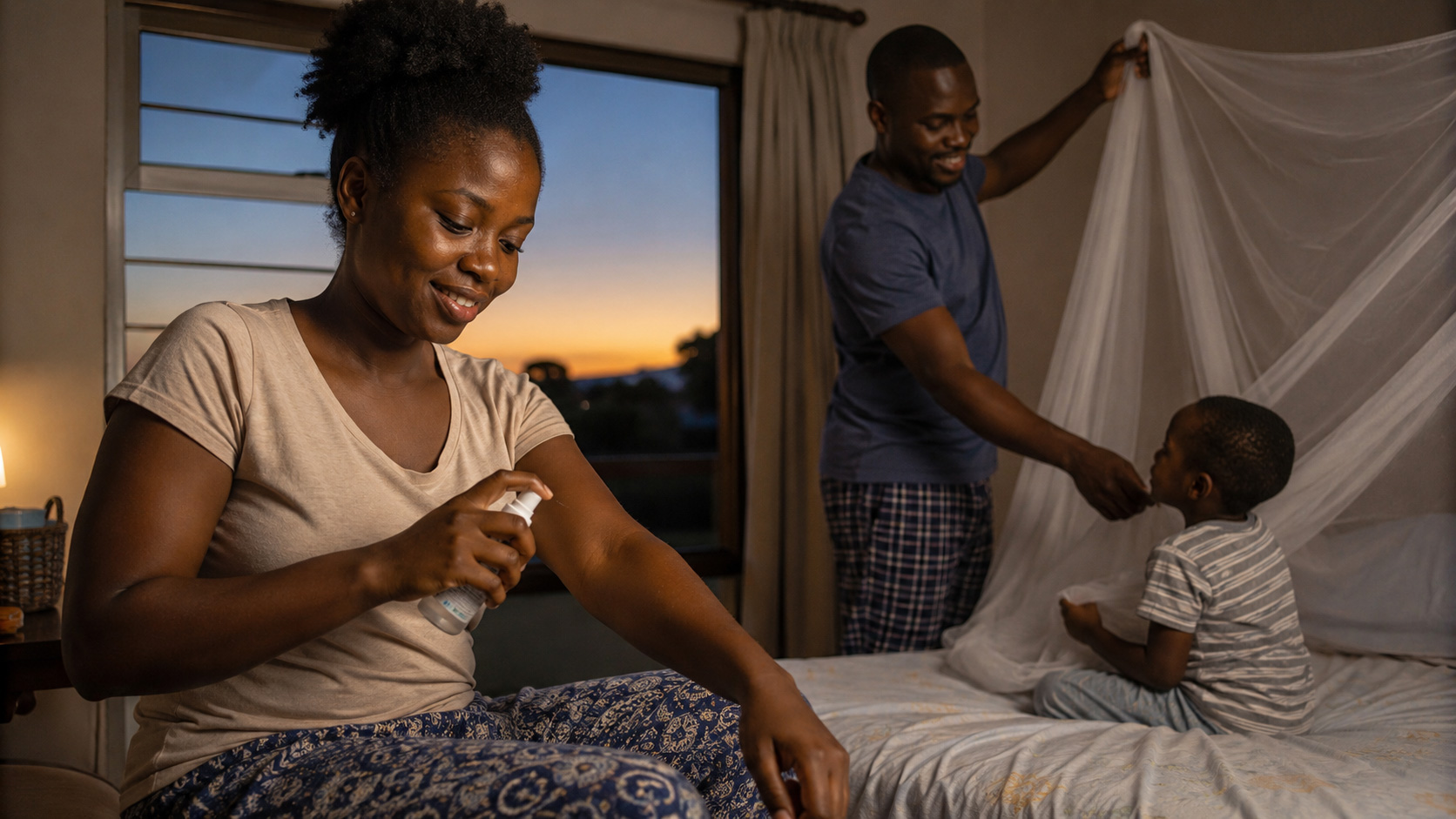
Preventing mosquito bites remains one of the most effective ways of reducing malaria risk.
Use Mosquito Repellent
Apply an appropriate insect repellent to exposed skin, particularly from late afternoon through the night when malaria-carrying mosquitoes are most active.
Follow the product instructions carefully.
Cover Exposed Skin
When practical, wear:
- Long trousers
- Long-sleeved clothing
- Socks
- Closed shoes
This is particularly useful in the evenings.
Sleep Under a Mosquito Net Where Recommended
In malaria-risk areas, insecticide-treated mosquito nets can provide an important additional layer of protection while sleeping.
Make sure the net is properly tucked in and does not have holes.
Use Screens and Indoor Protection
Window and door screens can help reduce mosquitoes entering a home.
Other mosquito-control measures recommended for your local area may also help.
Reduce Standing Water
Mosquitoes breed in water.
Around the home, regularly check:
- Buckets
- Open containers
- Old tyres
- Plant trays
- Gutters
- Water-storage containers
- Other places where rainwater can collect
Where possible, empty, clean or securely cover containers.
What About Malaria Prevention Medication?
Preventative malaria medication may be recommended for travellers visiting certain malaria-endemic areas.
Whether you need medication depends on several factors, including:
- Your destination
- The season
- Duration of travel
- Your age
- Pregnancy
- Existing medical conditions
- Medication you already take
A healthcare professional can help you determine whether malaria prophylaxis is appropriate.
It is best to ask before travelling, rather than trying to organise medication once you’re already on your trip.
And remember: malaria prevention medication does not replace mosquito-bite prevention.
No single preventative method offers complete protection.
Pregnant? Take Extra Care
Malaria during pregnancy can be particularly serious.
Pregnant women travelling to or living in malaria-risk areas should speak to a healthcare professional about appropriate prevention.
Not all malaria-prevention medicines are suitable during pregnancy.
Do not simply take medication given to another traveller.
A doctor or pharmacist should advise you on the safest approach for your individual circumstances.
Why Every Case Matters When Elimination Is Close
When malaria affects thousands or millions of people, one individual case can feel like a tiny part of a much larger problem.
When a country is close to eliminating malaria, the picture changes.
Every case matters.
Healthcare teams can investigate:
- Where the infection was acquired
- Whether it was imported
- Whether mosquitoes may be transmitting malaria locally
- Whether other people in the area may have been exposed
- Whether mosquito-control interventions are needed
Eswatini’s high level of case investigation is one of the tools helping the country move towards elimination. WHO reported that 98% of confirmed cases during the 2024/25 season were investigated.
Telemedicine Can Help You Decide What to Do Next
If you have developed fever, headache, body aches or other flu-like symptoms and you’re unsure whether you need medical assessment, a virtual consultation can be a useful first step.
Through TruMD Eswatini, you can tell a healthcare professional:
- What symptoms you’re experiencing
- When they started
- Where you’ve recently travelled
- Whether you’ve had mosquito exposure
- Which medication you’re taking
- Whether anyone travelling with you is also sick
A healthcare professional can then determine whether you need malaria testing or another form of medical assessment.
Malaria itself cannot be reliably diagnosed through symptoms alone.
If malaria is suspected, appropriate testing will be needed.
And if you are seriously unwell, emergency or urgent in-person care should not be delayed for an online consultation.
The Final Stretch Requires All of Us
Eswatini has already achieved something significant.
Malaria transmission has been pushed to very low levels, surveillance has improved and the possibility of eliminating the disease is becoming increasingly realistic.
But the final stretch can be one of the hardest.
It requires communities to continue preventing mosquito bites.
It requires travellers to remain aware.
It requires healthcare professionals to keep considering malaria when symptoms fit.
And it requires people with possible symptoms to get tested rather than assuming it’s simply flu.
This World Mosquito Day, Eswatini has more than malaria prevention to think about.
We have the possibility of helping end local malaria transmission altogether.
Feeling Unwell After Travelling?
If you have developed fever, chills, headache or flu-like symptoms after travelling through a malaria-risk area, don’t ignore your travel history.
TruMD Eswatini connects you with qualified healthcare professionals through convenient online consultations, helping you get medical guidance and determine whether further testing or in-person care is needed.
Feeling unwell? Talk to a doctor with TruMD Eswatini.